
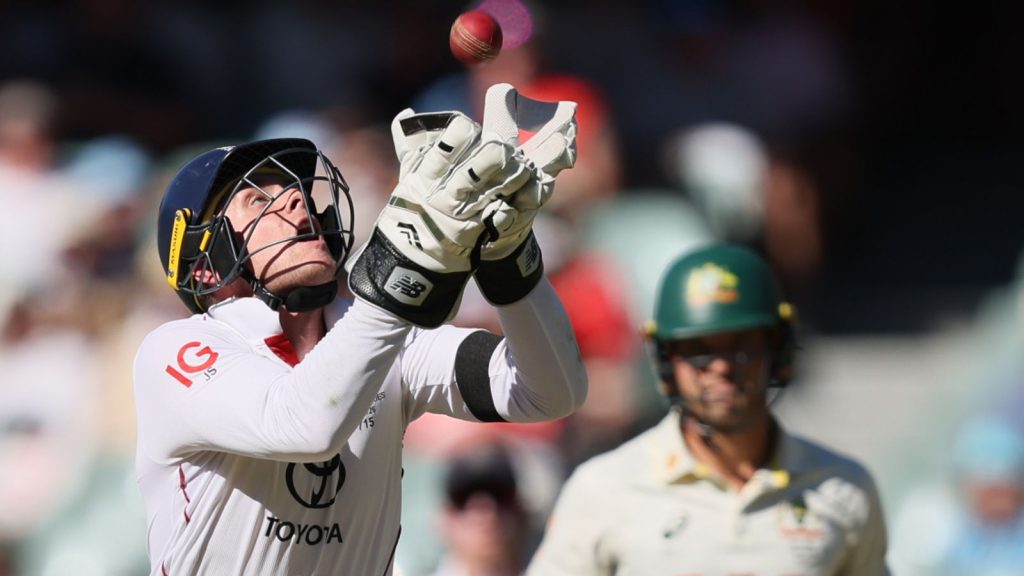
The controversy surrounding Alex Carey’s escape on the opening day of the third Ashes Test has deepened, with the operators of Snicko admitting that a technical error directly led to an incorrect not-out decision.
Carey went on to score a commanding maiden Ashes century, guiding Australia to 326 for 8, but his innings might have ended on 72 when England appealed for a caught-behind off Josh Tongue. On-field umpire Ahsan Raza ruled him not out, prompting an immediate review from England, convinced there had been an edge.
Replays showed a distinct noise as the ball passed Carey’s bat, accompanied by a prominent spike on the Snicko trace. However, TV umpire Chris Gaffaney upheld the original decision, noting that the audio spike appeared before the ball reached the bat, leaving him without conclusive evidence to overturn the call.
Before play resumed on the second morning, it was confirmed that England’s review would be reinstated — a move that followed Carey’s own admission after stumps that he believed he had edged the delivery. The bigger revelation came later when BBG Sports, the company that owns and operates Snicko, accepted full responsibility for the error.
In a statement, BBG revealed that the wrong stump microphone had been selected during audio processing, most likely from the bowler’s end. This mistake caused the audio and video feeds to fall out of sync, producing the misleading spike that undermined the review.
“Given that Alex Carey admitted he had hit the ball in question, the only conclusion that can be drawn is that the Snicko operator selected the incorrect stump mic for audio processing,” BBG said. “In light of this, BBG Sports takes full responsibility for the error.”
Carey, who went on to score 106, had earlier acknowledged the moment. “I thought there was a feather or some sort of noise when it passed the bat,” he said. “If I was given out, I think I would have reviewed it — probably not confidently. It was a nice sound as it passed the bat.”
England’s bowling coach David Saker voiced the tourists’ growing frustration even before confirmation of the mistake. “There have been concerns about it for the whole series,” he said. “We shouldn’t be talking about this after a day’s play — it should just be better than that.”
The incident has reignited debate over the reliability of Real-Time Snicko, particularly after earlier controversies in the series. In the first Test, England wicketkeeper Jamie Smith was given out caught behind despite a spike that also appeared out of sync, with officials citing a permissible frame gap between audio and visuals.
Former England fast bowler Steven Finn was scathing in his assessment, calling for the technology to be scrapped altogether. “Ashes series usually end people’s careers,” Finn said on TNT Sport. “It might be the end of Snicko’s career at the end of this one. It’s performed awfully throughout the series.”
Michael Atherton, speaking on the Sky Sports Cricket Podcast, struck a more measured tone. While agreeing the decision was likely wrong, he defended the third umpire’s position. “The on-field decision was not out, so the TV umpire has to be absolutely certain to overturn it,” Atherton said. “With the spike and visuals so badly out of sync, I’m not sure what other decision he could have made.”
Australia currently lead the five-match Ashes series 2–0, and England must win the third Test to keep the contest alive. Whether Carey’s reprieve proves decisive in shaping the outcome remains to be seen, but the Snicko error has already left an indelible mark on the series — and on the credibility of the technology itself.
